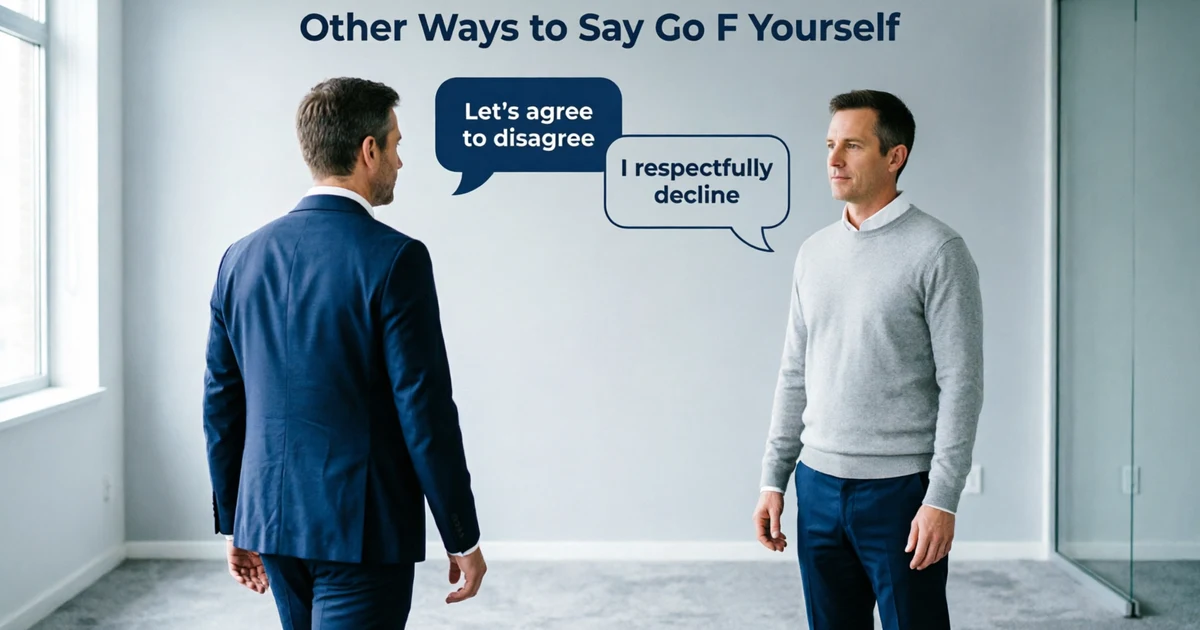
Using harsh language can quickly damage a conversation. While the phrase Go F Yourself expresses strong anger or frustration, it is often offensive and inappropriate in most situations. Fortunately, there are many other ways to express annoyance, set boundaries, or dismiss someone without using explicit profanity.
Whether you are writing dialogue, responding to an argument, or simply expanding your vocabulary, knowing other ways to say Go F Yourself can help you choose words that match the situation and your tone.
Quick Answer
There are many alternatives to Go F Yourself, ranging from polite boundary-setting phrases like Please leave me alone to sarcastic expressions like Take a hike. The best choice depends on whether you want to sound calm, humorous, firm, or openly angry.
TL;DR
- Meaning: A strong expression telling someone to leave or stop bothering you.
- Tone: Usually rude, angry, or dismissive.
- Common use: Arguments, online discussions, and fictional dialogue.
- Best alternative: Choose a phrase that fits your situation and audience.
- Formality: Highly informal and generally inappropriate in professional settings.
What Other Ways to Say Go F Yourself Means
The original phrase is one of the strongest insults in English. People usually say it when they feel extremely angry, frustrated, or offended.
However, it often ends conversations instead of solving problems. Because of that, many people prefer alternatives that communicate the same feeling without using explicit language.
Some replacements sound firm but respectful, while others use humor or sarcasm to make a point.
Basic Explanation
Not every disagreement needs an offensive response.
Depending on the situation, you may want to:
- End the conversation.
- Tell someone to leave you alone.
- Show disagreement.
- Set a personal boundary.
- Respond with humor.
- Express frustration without swearing.
Choosing the right words often leads to a better outcome.
50 Other Ways to Say Go F Yourself
Polite but Firm Alternatives
| Alternative | Best For | Tone |
|---|---|---|
| Please leave me alone | Everyday conversations | Polite |
| I’d rather end this conversation | Disagreements | Calm |
| Let’s agree to disagree | Debates | Respectful |
| I don’t wish to continue this discussion | Professional settings | Formal |
| Please respect my boundaries | Personal conflicts | Firm |
| I’m done discussing this | Arguments | Direct |
| Let’s move on | Minor disagreements | Neutral |
| I’d appreciate some space | Personal situations | Calm |
| I’m ending this conversation | Online chats | Firm |
| I think we’re finished here | Difficult discussions | Professional |
Casual Alternatives
| Alternative | Best For | Tone |
|---|---|---|
| Take a hike | Friends or light arguments | Casual |
| Get lost | Informal disagreements | Blunt |
| Leave me alone | Everyday situations | Direct |
| Give it a rest | Repeated arguments | Casual |
| Knock it off | Friendly disagreements | Firm |
| Back off | Personal boundaries | Direct |
| Move along | Online comments | Dismissive |
| Go bother someone else | Everyday use | Casual |
| Cut it out | Friends | Firm |
| That’s enough | Family conversations | Neutral |
Sarcastic or Funny Alternatives
| Alternative | Best For | Tone |
|---|---|---|
| Have the day you deserve | Internet humor | Sarcastic |
| Thanks for your opinion | Online debates | Dry |
| Good luck with that | Arguments | Sarcastic |
| Bless your heart (context dependent) | Light sarcasm | Polite |
| That’s certainly a choice | Social media | Witty |
| Interesting perspective | Debates | Dry |
| I’ll let you think that | Casual conversations | Sarcastic |
| You do you | Minor disagreements | Casual |
| Whatever helps you sleep at night | Arguments | Sarcastic |
| Noted | Text messages | Dismissive |
Strong but Non-Profane Alternatives
| Alternative | Best For | Tone |
|---|---|---|
| I’m done with this | Heated discussions | Firm |
| We have nothing more to discuss | Serious disagreements | Professional |
| This conversation is over | Conflict resolution | Direct |
| I won’t tolerate that | Boundary setting | Firm |
| That’s unacceptable | Workplace | Professional |
| Please stop contacting me | Persistent messages | Direct |
| I disagree completely | Debates | Respectful |
| That’s enough for today | Family conflicts | Calm |
| Let’s end this here | Workplace | Neutral |
| I need to walk away | Emotional situations | Calm |
Creative Alternatives
| Alternative | Best For | Tone |
|---|---|---|
| Find someone else to argue with | Online discussions | Casual |
| Save your energy | Friendly debates | Light |
| I’m not interested | Unwanted conversations | Direct |
| We clearly see this differently | Discussions | Respectful |
| I have nothing else to add | Professional | Neutral |
| This isn’t worth my time | Arguments | Firm |
| Let’s leave it there | Everyday disagreements | Calm |
| Enjoy the rest of your day | Ending conversations | Neutral |
| We’ll have to leave it at that | Formal conversations | Professional |
| I wish you well | Ending conflict politely | Calm |
Tone and Emotional Meaning
Different alternatives communicate different emotions.
Professional
These expressions work well when you want to stay respectful.
- I don’t wish to continue this discussion.
- We have nothing more to discuss.
- Please respect my boundaries.
Friendly
These work in minor disagreements.
- Give it a rest.
- Cut it out.
- Let’s move on.
Sarcastic
These are common online but may still offend some people.
- Have the day you deserve.
- Good luck with that.
- Whatever helps you sleep at night.
Direct
These clearly end the conversation.
- Back off.
- Leave me alone.
- This conversation is over.
Common Situations Where These Alternatives Work
You might use these expressions when:
- Ending an online argument.
- Responding to rude comments.
- Setting personal boundaries.
- Dealing with persistent messages.
- Handling disagreements with friends.
- Closing an unproductive discussion.
- Responding to trolling on social media.
- Walking away from an argument.
Choosing a calmer alternative often helps reduce conflict instead of escalating it.
Examples in Real Conversations
Situation
Someone keeps sending unwanted messages.
Example
Please stop contacting me. I don’t want to continue this conversation.
Meaning
Clear, respectful, and firm.
Situation
A friend keeps teasing you.
Example
Give it a rest. You’re taking the joke too far.
Meaning
Sets a boundary without becoming insulting.
Situation
An online debate becomes unproductive.
Example
We’ll have to agree to disagree. Have a good day.
Meaning
Ends the conversation respectfully.
Situation
Someone ignores your requests.
Example
I’m ending this conversation now.
Meaning
Directly communicates your decision.
Situation
A sarcastic reply online.
Example
Have the day you deserve.
Meaning
A sarcastic way to end an argument without using profanity.
Similar Terms and Related Phrases
| Phrase | Difference |
|---|---|
| Get lost | Blunt but less vulgar |
| Take a hike | More humorous and less offensive |
| Back off | Tells someone to stop interfering |
| Leave me alone | Focuses on personal space |
| Drop it | Asks someone to stop discussing a topic |
| Go away | Simple and direct |
| Mind your own business | Tells someone to stop interfering |
| Agree to disagree | Ends a discussion respectfully |
When You Should Use These Alternatives
The right expression depends on your goal. Sometimes you want to end a conversation peacefully. Other times, you simply need to set a clear boundary.
These alternatives work well in situations such as:
- Ending an unproductive argument.
- Responding to rude or disrespectful behavior.
- Asking someone to stop contacting you.
- Dealing with online trolls.
- Setting personal boundaries.
- Walking away from a heated discussion.
For example, if a coworker keeps pushing an issue after you’ve explained your position, a calm response like I think we’re finished here is usually more effective than an insult.
Likewise, if someone continues to send unwanted messages, Please stop contacting me clearly communicates your boundary without escalating the situation.
When You Should Avoid Them
Even mild alternatives can sound harsh if you use them at the wrong time.
Avoid dismissive phrases when:
- A simple misunderstanding can be resolved through conversation.
- The other person is asking a genuine question.
- You are speaking with a customer or client.
- You are writing a professional email.
- The conversation involves a sensitive personal issue.
Instead, try phrases such as:
- I think we’ve misunderstood each other.
- Let’s come back to this later.
- I appreciate your perspective, but I see it differently.
- I don’t think we’re going to agree.
These responses keep the discussion respectful while protecting your boundaries.
Is It Formal or Informal?
Most alternatives to Go F Yourself belong in casual conversations. However, some work well in professional settings.
| Expression | Formality | Best Setting |
|---|---|---|
| Please leave me alone | Neutral | Everyday conversations |
| Let’s agree to disagree | Professional | Meetings and discussions |
| I don’t wish to continue this discussion | Formal | Workplace |
| We have nothing more to discuss | Professional | Business conversations |
| Take a hike | Informal | Friends |
| Get lost | Informal | Casual arguments |
| Back off | Informal | Personal conflicts |
| Have the day you deserve | Informal | Social media |
| Enjoy the rest of your day | Neutral | Ending conversations politely |
| I wish you well | Neutral | Respectful endings |
In general:
Formal
Use these in workplaces or professional communication.
- I don’t wish to continue this discussion.
- We have nothing more to discuss.
- Let’s agree to disagree.
- I think we’re finished here.
Informal
These fit casual conversations but may still sound blunt.
- Take a hike.
- Get lost.
- Back off.
- Give it a rest.
Common Misunderstandings
People sometimes assume every alternative carries the same level of anger. That is not true.
Not Every Phrase Is an Insult
Expressions such as Let’s move on or I think we’re finished here simply end a conversation. They are not personal attacks.
Sarcasm Can Be Misread
Online messages lack facial expressions and voice tone. As a result, phrases like Have the day you deserve may seem much harsher than intended.
Context Changes the Meaning
A close friend might laugh at Take a hike, while a stranger could find it rude. Consider your relationship with the other person before choosing your words.
Professional Settings Require Care
Even mild dismissive phrases can appear disrespectful in the workplace. When possible, stay calm and focus on the issue instead of the person.
USA and Tier 1 Country Usage
Across the United States, Canada, the United Kingdom, Australia, and New Zealand, the original phrase is widely understood as a very offensive insult.
In professional environments, people usually replace it with calmer expressions that end the conversation without creating unnecessary conflict.
On social media, however, humorous alternatives have become increasingly popular. Phrases like Have the day you deserve or Good luck with that often appear in online debates because they express frustration without using explicit profanity.
Even so, cultural expectations vary. What sounds playful among close friends may seem disrespectful in another setting. Therefore, consider both your audience and the situation before using a dismissive expression.
Quick Reference Table
| Context | Recommended Alternative | Tone | Best Use | Avoid If |
|---|---|---|---|---|
| Workplace disagreement | I don’t wish to continue this discussion | Professional | Meetings | Casual chats |
| Online argument | Let’s agree to disagree | Respectful | Social media | Serious conflicts |
| Unwanted messages | Please stop contacting me | Firm | Personal boundaries | Minor misunderstandings |
| Friend teasing you | Give it a rest | Casual | Friendly conversations | Formal settings |
| Heated discussion | I’m ending this conversation | Direct | Ending arguments | Collaborative discussions |
| Persistent criticism | Please respect my boundaries | Calm | Personal relationships | Lighthearted jokes |
| Internet trolling | Have the day you deserve | Sarcastic | Online comments | Professional communication |
| Ending politely | I wish you well | Respectful | Closing conversations | Active disagreements |
Conclusion
Knowing other ways to say Go F Yourself gives you more control over how you communicate. While the original phrase is highly offensive, many alternatives let you express frustration, end a conversation, or set boundaries without using explicit language.
In most situations, calm and direct responses work better than insults. Whether you choose Let’s agree to disagree, Please leave me alone, or I’m ending this conversation, matching your words to the situation helps you communicate more effectively while avoiding unnecessary conflict.
Frequently Asked Questions
What are the best other ways to say Go F Yourself?
Some of the most useful alternatives include Please leave me alone, Take a hike, Back off, Let’s agree to disagree, and I’m ending this conversation.
Is Go F Yourself considered rude?
Yes. It is one of the strongest insults in English and is generally considered offensive in almost every situation.
What is a polite alternative?
Polite options include Please respect my boundaries, I’d rather end this conversation, Let’s move on, and I wish you well.
Can I use these alternatives at work?
Yes, but choose professional phrases such as I don’t wish to continue this discussion or We have nothing more to discuss instead of sarcastic or insulting expressions.
What is a funny alternative?
Common humorous options include Take a hike, Have the day you deserve, and Good luck with that. Their tone depends on the relationship and context.
Are these phrases appropriate on social media?
Some are commonly used online, but remember that sarcasm is easy to misunderstand. A respectful response often leads to a better outcome.
What is the difference between Go F Yourself and Get Lost?
Go F Yourself is much more offensive and aggressive. Get lost is still rude, but it is generally considered less vulgar and less explicit.